THE FRAMEWORK
Dentistry is created
through relationships
At the center of care is the person. Around them exists an interconnected network of relationships that shape how dentistry is experienced, practiced and ultimately delivered.
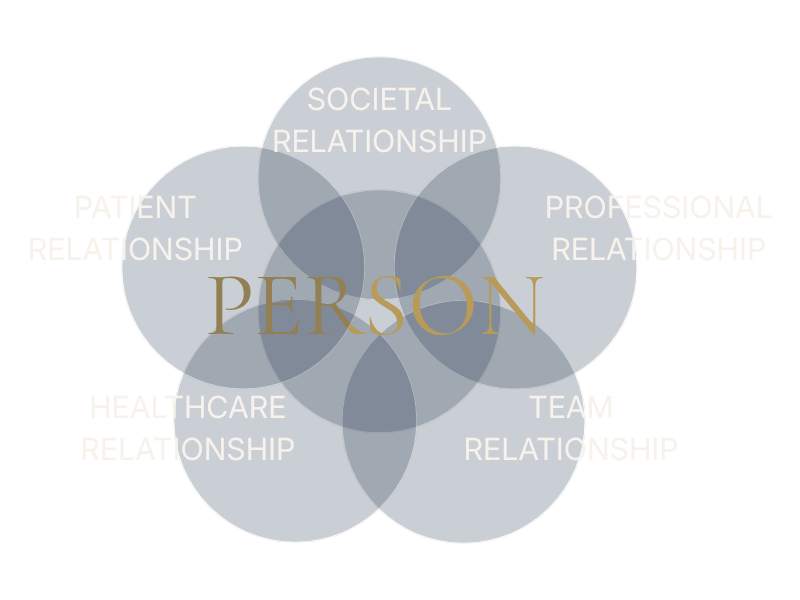
Care is created where these relationsips meet.
01
THE PATIENT RELATIONSHIP
Clinical excellence is built on trust.
Every patient arrives with a life beyond the dental chair. A diagnosis gives us essential clinical information. Listening helps us understand how a person experiences illness, uncertainty, pain, and care—and what matters to the person in front of us: their concerns, expectations, circumstances, and capacity to engage with treatment.
When we understand the person more fully, clinical decisions become more thoughtful. Communication becomes more meaningful. Care becomes more human.
Care begins with seeing the person.
The patient is an active participant in care.
Meaningful care develops through dialogue. The patient brings their own experiences, expectations, cultural context, values, and priorities into the clinical relationship. When these are understood alongside clinical expertise, treatment decisions can reflect both what is clinically appropriate and what matters to the person receiving care.
Understanding creates the foundation for meaningful guidance.
Every person brings a cultural perspective, personal values, previous experiences, and expectations into care. Curiosity and respectful communication help the dentist understand that perspective and build a relationship grounded in trust.
From that understanding, the dentist can offer clear recommendations shaped by clinical expertise and the individual circumstances of the person. The strongest decisions emerge through dialogue—bringing professional judgment and patient autonomy into a shared process of care.
Understanding the person strengthens the recommendation.
02
THE PROFESSIONAL RELATIONSHIP
Clinical excellence begins with technical expertise and is refined through lifelong professional growth.
Technical expertise provides the foundation for clinical practice. Lifelong learning, experience, reflection, and self-awareness continually refine how that expertise is applied.
Professional growth strengthens clinical judgment, supports adaptability, and deepens the dentist’s capacity to respond thoughtfully to the complexity of each person and each clinical situation.
The quality of care is shaped by the person providing it.
Technology strengthens care.
Human judgment gives it direction.
As digital technologies increasingly shape diagnosis and treatment planning, the human dimensions of care become even more valuable.
Technology can strengthen clinical decisions; judgment, communication, empathy, and ethical reasoning determine how those decisions serve the person before us.
Person-centered care requires the courage to recommend what genuinely serves the patient’s long-term health.
It calls for honest conversations, thoughtful guidance, and respect for each person’s values and choices. Professional integrity is reflected in helping patients make informed decisions with clarity, empathy, and trust—even when the recommended path is difficult or requires time to accept.
Clarity with empathy.
Guidance with respect.
Courage with integrity.
The quality of our care reflects the quality of the professional we choose to become.
03
THE TEAM RELATIONSHIP
Exceptional care requires teamwork.
The quality of care is inseparable from the quality of the team delivering it. Every member of the dental team contributes knowledge, skill, perspective, and experience that shape the patient’s experience and the clinical outcome.
When expertise is shared and communication flows openly, the team becomes more than a collection of individual roles. It becomes a coordinated system of care.
Strong teams create space for every voice to contribute.
Psychological safety allows team members to ask questions, raise concerns, acknowledge uncertainty, and contribute their perspective openly. It creates an environment where expertise can be shared, assumptions can be examined, and learning becomes part of everyday practice.
When people feel respected and heard, communication becomes stronger, collaboration deepens, and the team is better equipped to recognize challenges early and respond together.
Leadership creates the conditions for teams to thrive.
Leadership shapes how a team communicates, collaborates, and responds to challenges. Clear expectations, consistency, trust, and shared responsibility create an environment where people can contribute their expertise and grow together.
Effective leadership also recognizes the human experience of the team. Supporting professional development, wellbeing, and mutual respect strengthens both the people providing care and the care they are able to provide.
The way we lead becomes part of the way we care.
Care is a shared practice.
A strong clinical team expands what becomes possible for the patient.
04
THE HEALTHCARE RELATIONSHIP
Oral health is part of human health.
Oral health is influenced by disease, medication, nutrition, wellbeing, aging, and the wider circumstances of a person’s life. Understanding these connections allows dental care to be considered within the broader context of human health.
Shared knowledge creates more connected care.
When knowledge is shared across disciplines, we begin to see the person more completely. Clinical decisions gain context. Risks become clearer. Care becomes more connected.
Collaboration across healthcare brings different areas of expertise into conversation, creating a broader understanding of the factors that influence oral and overall health.
Dentistry is part of whole-person healthcare.
Interdisciplinary collaboration brings dental expertise into conversation with the wider healthcare system. Each discipline contributes its own knowledge and perspective, creating opportunities for more informed decisions and more connected care.
Recognizing oral health as an integral part of healthcare strengthens our ability to understand and care for the whole person.

05
THE SOCIETAL RELATIONSHIP
Health is shaped long before a person enters the clinical setting.
Every patient arrives carrying influences that extend far beyond the mouth. Culture, education, nutrition, financial resources, relationships, stress, work, and community all shape health long before we begin treatment.
Understanding begins with curiosity, compassion, and respect.
Every person brings experiences and circumstances that have shaped their health, expectations, choices, and relationship with care. Approaching those influences with curiosity, compassion, and respect allows us to understand the person more fully.
From that understanding, treatment recommendations become conversations grounded in partnership. They can reflect both clinical expertise and the realities, priorities, and circumstances of the person receiving care.
The future of dentistry extends beyond the clinic.
Understanding the lives people live beyond the dental setting gives greater context to the care we provide. Health develops within families, cultures, communities, workplaces, and everyday circumstances—and each of these influences enters the clinical relationship with the person.
When dentistry remains connected to that wider human context, care becomes more thoughtful, relevant, and responsive to the person receiving it.
Every recommendation we make enters a life already in progress.
Every conversation.
Every decision.
Every act of compassion.
Every partnership.
Each helps shape what comes next.